A 1893 Envelope Addressed to The Bank of Bombay
Bank of Bombay
The Story
The bank was established in 1840 and was based in Bombay. Though, a commercial bank, it undertook certain functions of Central Bank as the Reserve Bank of India was not established at that time. It was merged with the two other Presidency Banks, the Bank of Calcutta and the Bank of Madras and was renamed Imperial Bank of India in 1921. In 1955 the merged entity was renamed the State Bank of India. Bank.
Envelopes Addressed to the Bank of Bengal : Agra - 1895; Cawnpore - 1899; Hyderabad - 1905
Bank Of Bengal
The Story
The Bank of Calcutta was founded in 1806 and was renamed Bank of Bengal in 1809.
The bank was risk averse and limited lending to a period of three months, leading to launch of other banks, many of which failed. The Bank of Calcutta, and the two other Presidency banks i.e., the Bank of Bombay and the Bank of Madras amalgamated in 1921 to form the Imperial Bank of India. In 1955 the merged entity was renamed as the State Bank of India.
The sender of the 1905 envelope is National Bank of India. See postal history of National Bank of India here and read about the bank here.
A 1945 letter from Bank of Bengal can be seen here.
Source:
Imperial Bank of India
A 1900 Envelope to Oudh and Rohilkhand State Railway
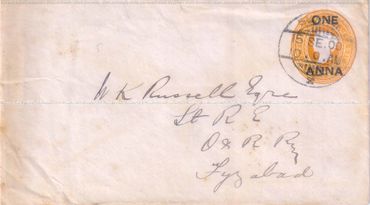
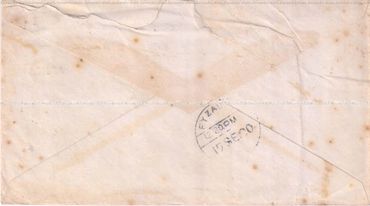
Oudh and Rohilkhand State Railway
The Story
In 1867, the first locomotive puffed between Lucknow and Cawnpore, a mere 42 miles that would ignite a revolution across northern India. The Indian Branch Railway Company had opened this line, but it was the ambitious Oudh and Rohilkhand Railway (O&RR), formed in 1872, that would transform this modest beginning into an extensive network spanning over 1,187 miles of broad-gauge track.
The railway's headquarters stood in Lucknow, the cultural heart of Oudh, from where engineers and managers plotted lines that would weave through the fertile plains of Rohilkhand. By 1872, the O&RR had already sprinted ahead: tracks reached from Lucknow to Hardoi, from Lucknow to Barabanki, and from Moradabad to Chandausi. By 1873, Bareilly welcomed the iron horse, and in 1874, the most dramatic achievement materialized, a continuous line from Benares to Lucknow, complete with the Fyzabad Loop extending eastward.
The railway's crowning engineering feat arrived in 1883 - the Dufferin Bridge over the Ganges at Benares. Under Chief Engineer Frederick Thomas Granville Walton's supervision, this massive structure connected the O&RR to the East Indian Railway Company's network at Mughalsarai, creating a direct artery across the river that had long divided northern India. The bridge enabled passengers to travel from Varanasi straight to the hill stations beyond, linking Allahabad to Lucknow in a single journey.
By the end of 1877, the company possessed 88 steam locomotives, 331 coaches, and 2,244 goods wagons, a formidable fleet that carried both pilgrims and merchants. Steam locomotive No. 11, an 0-6-0 workhorse, and the elegant 4-4-0 named "Lucknow" pulled trains through villages where smoke from the engines first startled cattle and curious children alike.
The railway's expansion continued relentlessly. In 1876, the line extended to Saharanpur, where the O&RR finally met the Northwestern Railway, creating a crucial junction. A branch from Laksar to Haridwar opened in 1883, serving the holy city. The Lucknow-Rae Bareilly extension completed in 1893, and the Bareilly-Moradabad link via Rampur in 1894, shortened the main line distance significantly. The Ghaziabad-Moradabad link in 1898 brought the railway closer to Delhi.
Yet the O&RR's private era ended abruptly. On 31 December 1888, the Government of India assumed both ownership and management, transforming it into the Oudh and Rohilkhand State Railway. The government guarantee that had enabled its early expansion now gave way to direct state control. This transition reflected broader colonial policy shifts toward centralized railway management.
The railway continued under state management for nearly four more decades until 1 July 1925, when it merged into the East Indian Railway Company, which had itself come under state management. The network's workshops at Alambagh (established 1865) and Charbagh (1867) continued serving the expanded system.
For passengers traveling through colonial India, the O&RR represented something profound: the ability to traverse vast distances with unprecedented speed. As Ken Staynor later recounted of railway travel during the Raj, the railways "provided the enormous nation with unlimited connectivity and vital transportation," allowing fast travel between one end of the country and the other. The O&RR's lines connected major cities — Aligarh, Allahabad, Bareilly, Cawnpore, Delhi, Lucknow, Moradabad, and Saharanpur, binding them into a commercial and cultural network.
The railway's legacy endures in the modern tracks that still follow its routes. In 2017, many of its lines were converted to 5 ft 6 in broad gauge, continuing the O&RR's original vision of connecting northern India. From the humble 42-mile beginning between Lucknow and Cawnpore to a 1,910-kilometer network, the Oudh and Rohilkhand Railway transformed the plains of Uttar Pradesh, carrying the dreams, commerce, and history of Indians on its iron rails.
References:
https://en.wikipedia.org/wiki/Oudh_and_Rohilkhand_Railway https://wiki.fibis.org/w/Oudh_and_Rohilkhand_Railway https://wiki.fibis.org/w/O%26RR_Lines_Owned_and_Worked https://wiki.fibis.org/w/O%26RR_Lines_Owned_and_Worked https://www.indiaofthepast.org/ken-staynor/life-back-then/railway-travel-raj https://indianrailways.gov.in/railwayboard/uploads/codesmanual/ADMIN_FINANCE/AdminFinanceCh1_Data.htm https://artsandculture.google.com/story/a-history-of-indian-railways-national-rail-museum/cAVh7RwiKiTtKg?hl=en
A 1912 Card from Standard Vacuum Oil, A 1941 Envelope to Standard Vacuum & A 1937 Envelope to Socony Vacuum
Standard Vacuum Oil Company
The Story
The envelope above travelled from Portuguese India to British India.
The Standard Vacuum Oil Company was established in 1931 as a joint venture between Standard Oil of New Jersey and Socony-Vacuum Oil (See envelope addressed to New York City above), which was later known as Mobil. Socony stood for the Standard Oil Company of New York which was formed in 1882. Vacuum Oil was formed in 1866. In 1931, Socony had merged with Vacuum Oil to create Socony-Vacuum Oil.
During the 1950s, disagreements arose between the partners, ultimately leading to their split in 1962. As a result, two companies were formed: Jersey Standard Southeast Asia and Mobil Oil Southeast Asia. Interestingly, in 1999, the two entities reunited, merging to form the now-famous ExxonMobil.
In India, the company started its operations in 1910 as Standard Oil Company of New York and thereafter changed its name in 1931 to Socony-Vacuum Oil. In 1951, the company signed an agreement with Government of India to set up a refinery at Trombay. A new company Standard Vacuum Refining Company of India was incorporated. The company started manufacturing motor gasoline and expanded to LPG, JBO, asphalt, SBP spirit, hexane, naptha, petroleum ether and propane.
In 1954, Socony-Vacuum Oil built the iconic Petroleum House in Bombay and relocated its headquarters there, which was inaugurated by the then Chief Minister, Morarji Desai. The building was notable for its modern and environmentally friendly design, featuring open office spaces. In 1974, the company was nationalized and rebranded as Hindustan Petroleum Corporation Limited (HPCL).
The sender of the letter is Vita Pack Corporation. Not much is known about Vita Pack Corporation, but the company played a significant role in the history of cashew nut exports from India. In the late 1920s, American businessmen from Vita Pack Corporation and General Food Corporation collaborated with Shri Narayan Zantye, a pioneer in the cashew processing industry in Goa. They provided technical and financial assistance to successfully export cashew kernels to the U.S. for the first time in 1928. This partnership marked the beginning of a thriving cashew export industry in Goa.
A 1920 Envelope From Udaipur-Chittorgarh Railway


Udaipur Chittorgarh Railway
The Story
An example of state-owned or shall we say kingdom-owned enterprise. The railway journey between Udaipur and Chittorgarh was an attempt by the princely state of Mewar to connect its inland capital with the wider commercial and political networks emerging across nineteenth-century Rajasthan.
The idea took shape during the reign of Maharana Sajjan Singh. In 1884, he commissioned a survey for a railway to Udaipur, to improve public convenience and encourage trade. The survey and preliminary estimates were completed within a year, but the Maharana’s death brought the project to a standstill. A decade later, Maharana Fateh Singh revived the plan. The first section, running from Chittorgarh towards Debari, was opened on 1 August 1895. The final stretch from Debari to Udaipur, approximately 6.5 miles long, opened on 25 August 1899.
The line was built as a metre-gauge - the capital expenditure was nearly 21 lakhs up to the end of 1904 and the net profits averaged about 5 per cent. Records compiled by the families in British India Society describe it as a 67-mile line sponsored by the Mewar State Durbar and initially worked by the Bombay, Baroda and Central India Railway. Chittorgarh provided the crucial connection with the Rajputana–Malwa railway system, linking Mewar with routes extending towards Ajmer, Ahmedabad, Indore and northern India.
For Udaipur, the railway changed the character of the capital. Until then, its position among the Aravalli hills had offered security but also imposed limits on movement. The new line brought pilgrims, traders, officials and travellers closer to the city. It also made the movement of goods more reliable, strengthening Udaipur’s relationship with markets beyond the Mewar State.
The railway’s construction was difficult. The route crossed hard, hilly terrain, and labourers excavated sections by hand with chisels and hammers. One surviving reminder of that effort is the Debari tunnel, built in 1889 and approximately 90 metres long. It is Rajasthan’s longest heritage railway tunnel – however, now in disuse as metre-gauge track was replaced by broad gauge in 2005. A toy train is being planned for the tunnel.
After independence, in 1948, the control passed to the government in 1948, and it was known as Rajasthan State Railway. Two years later in April 1950, it became the property of the GOI as a result of Federal Financial Integration.
Sources:
https://thetimbertrawler.com/tag/chittorgarh/
https://en.wikipedia.org/wiki/Chittaurgarh_Junction_railway_station
A 1923 Envelope to Eastern Bengal Railway
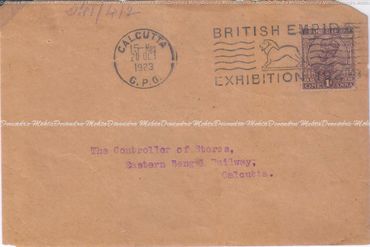
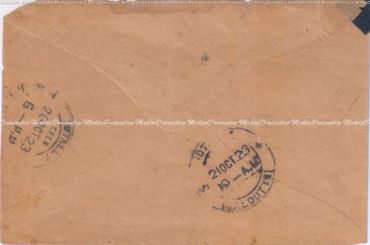
Eastern Bengal Railway
The Story
In the shadow of the 1857 Indian Rebellion, a quiet revolution was being forged in London. On July 30, 1858, the Eastern Bengal Railway Company signed a contract with the East India Company for a transformative mission: connecting Calcutta on the eastern bank of the Hooghly River to Kushtia, a distance of 110 miles estimated at one million pounds sterling .
Railways had arrived in England during the Industrial Revolution of the 1820s, but British capitalists doubted their commercial profitability in distant colonies like India. The government resolved this by offering a 5% guaranteed interest on capital invested, attracting British capital to build India's railways. The first railway line in India was introduced in 1853 between Bombay (now Mumbai) and Thane. The success of this line encouraged the British to expand railway networks across India, including Bengal.
The railway was planned to serve densely populated districts north and east of Calcutta, rich in agricultural produce — indigo, sugar, oilseeds, and rice. The line opened for the entire length in November 1862, ending at a tin-roofed station room at Sealdah, Calcutta's first railway terminal. A short branch line, two and a half miles long, extended from near Kushtia to a river port on the Garai River by 1864.
In 1865, the decision was made to extend the line from Kushtia 45 miles to Goalundo, at the confluence of the Ganges and Brahmaputra rivers. This required constructing a bridge over the Garai River. Viceroy Lord Mayo opened the extended line on December 31, 1870.
The government purchased the railway in 1884 through the Eastern Bengal Railway Company Purchase Act. In 1885, the Eastern Bengal Railway, which operated east of Hooghly River, was linked by a bridge between Bandel and Naihati, with the East Indian Railway, which operated west of Hooghly River. In 1887, it amalgamated with the Northern Bengal State Railway and was renamed it Eastern Bengal State Railway.
The railway had proved its worth immediately. By 1865, revenue alone maintained the entire railway, shifting from capital charges to self-sustaining operation. It used Burdwan coal from the start, with fuel costs dropping after bridges at Naihati and Howrah were completed.
The 1895 opening of the Assam-Bengal Railway between Chittagong and Comilla served tea companies exporting via Chittagong port. By 1902, the railway stretched north along the Brahmaputra's north bank to Dhubri in Eastern Assam, driven partly by pressure from the Indian Tea Association seeking an easy outlet for Assam tea to Calcutta. On January 1, 1942, Eastern Bengal State Railway and Assam Bengal Railway amalgamated to form the Bengal and Assam Railway.
By the early 20th century, Bengal had more railways per area than any province except the United Provinces . The railway provided cheaper, faster, and more comfortable transport than the hazardous river journeys in country boats that had dominated pre-railway trade .
The 1947 Partition divided the railway. The Indian portion became part of Eastern Railway (Sealdah Division) and Northeast Frontier Railway, while East Pakistan's portion became Eastern Bengal Railway, later Pakistan Eastern Railway, and finally Bangladesh Railway after 1971.
As one contemporary observer noted, the railway "left an indelible mark on 19th-century developments in India," providing the foundation for modern economic expansion by facilitating passenger and freight movement at "hitherto unparalleled speeds". Today, the Sealdah Division serves six West Bengal districts between the Hooghly River and Bangladesh, continuing the historic journey.
Sources:
https://en.banglapedia.org/index.php/Eastern_Bengal_Railway
https://irfca.org/members/sites/mrinal/history_er.html
https://er.indianrailways.gov.in/print_section.jsp?lang=0&id=0%2C6%2C442%2C452
https://railpolice.wb.gov.in/HistoryofIndianRailwaysinWestBengal
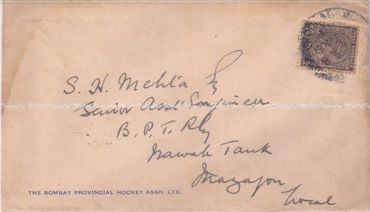
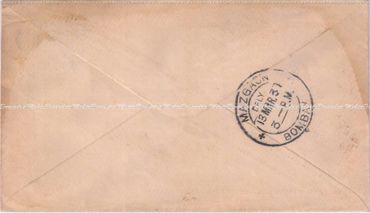
A 1937 Envelope to BPT Railway
BPT Railway
The Story
Before 1914, Bombay's docks existed in a kind of logistical limbo. Though ships unloaded their cargoes beneath the Arabian sun, the port remained strangely disconnected from the railway networks that were stitching together the Indian hinterland. Import and export goods moved from ship to rail, and vice versa, hauled in bullock carts across dusty roads. It was an expensive, slow method, bottlenecking the city's growing trade.
The two main railways, the GIP (later Central Railway) and the Bombay Baroda and Central Indian Railway (BB & CI), later Western Railway, had responded to rising traffic by laying capacious goods yards near Prince's and Victoria Docks, connected by just three sidings crossing Frere Road (now P. De'Mello Road). But these sidings could accommodate only a fraction of the port's volume. The city needed something bolder.
On 1 January 1915, the Bombay Port Trust Railway (also known as the Mumbai Port Trust Railway) was commissioned, changing the port's destiny forever. The designers enjoyed a rare advantage: ample land. This allowed them to adopt the best alignment and the most modern principles of railway transportation without disturbing existing interests. The result was a meticulously planned network linking the docks, bunders, and various depots to the two contiguous mainline railway systems.
The railway was small in size but mighty in impact. By 1969–70, its inward and outward traffic totalled 3.70 million tonnes, with an additional 1.67 lakh tonnes of local, station-to-station traffic . The Port Trust Railway handled about 60 per cent of Bombay city's total rail-borne goods traffic.
A Network of Ten Stations
The system spanned 11.3 route kilometres but boasted 312 track kilometres, a testament to its intricate web of sidings and depots. Ten stations served the docks and depots:
- Wadala Oil Depot
- Stores and Coal Depot
- Manganese Depot
- Grain Depot
- Cotton Depot
- Panton Bunder
- Prince's and Victoria Docks
- Alexandra Dock
- Ballard Pier
Wadala, at the extreme north end, functioned as the junction station and main marshalling yard. Goods trains arrived in the Up Arrival Yard, then were sorted over a hump by gravity – wagons rolled down and diverted along different lines by hand points. Outward loaded traffic received in the Down Arrival Yard was sorted over the Down Gravity Hump, forming trains for the Western and Central Railways and beyond.
The steam and diesel loco sheds sat at the south end of Wadala Yard, alongside a small goods shed. In 1936, the company owned 26 locomotives and 684 goods wagons. The last steam locomotives were retired in 1976, marking the end of an era.
The Port Trust Railway's role extended far beyond cargo. During World War II, it carried passengers and troops, serving the war effort. In the 1920s and 1930s, Ballard Pier Mole station became the starting point for the Frontier Mail (now the Golden Temple Mail), one of India's legendary long-distance trains. The excellent terminal railway facilities provided by the Bombay Port Trust contributed materially to the city's development; a direct consequence of that visionary 1915 project.
Sources:
https://en.wikipedia.org/wiki/Mumbai_Port_Trust_Railway
https://mumbaiport.gov.in/show_content.php?lang=1&level=1&ls_id=1042&lid=56
1939/40's Envelopes thru BB&CI Railway
BB&CI Railway
The Story
The first iron lungs that breathed steam over Bombay arrived when the city’s commercial pulse was already thrumming. In the mid‑19th century, Bombay, was a thriving entrepôt of cotton, opium and trade, a place where merchants needed speed as much as ships. Into that ferment the Bombay, Baroda and Central India Railway (BB&CI) was born in 1864, nine years after its incorporation, an enterprise formed to tie the city not only to Baroda but into the vast interiors of western and central India.
The company took shape in the 1850s and 1860s as private capital, colonial administration, and local princely interests converged. Early surveys and charters reflected a pragmatic aim: to provide a reliable trunk from Bombay northwest to Baroda, and to press further into the central Indian hinterland where markets and raw materials waited. The initial lines extended from Bombay through the expanding suburbs and coastal plains into Gujarat and Kathiawar, linking the metropolis with nodes such as Surat, Ahmedabad, Ankleshwar and Baroda and progressively reaching interior reaches of India – Godhra, Nagda, Ratlam, Ujjain, Bhawani Mandi (Jhalawar), Ajmer, Beawar, Kotah, Bayana and many more towns. Over time the network spread across Bombay Presidency territories and into princely states, forming a web that included the present-day areas of Gujarat, southern Rajasthan, western Madhya Pradesh and parts of Maharashtra. The main headquarters were at Churchgate in Bombay and the headquarter and workshops for meter gauge was at Ajmer.
Tracks that began as single corridors soon became arteries. Important early milestones include the company’s establishment and the progressive opening of sections through the 1860s and 1870s. By the late nineteenth century, the BB&CI had consolidated a network that carried both passengers and the commodities that sustained regional economies: cotton from inland fields to Bombay’s docks, salt and agricultural produce to market towns, and manufactured goods back into the countryside. The railway’s timetable compressed distances; journeys that once consumed days by bullock cart were now accomplished in hours, and that compression remade commerce and social life along the line.
The BB&CI’s practical engineering achievements unfolded alongside complex finance and political negotiation. Building across British-administered districts and princely states required treaties, guarantees, and capital arrangements that made the railway simultaneously a business venture and a political instrument. Workshops and locomotive sheds were established to maintain an expanding fleet; station complexes, goods yards and signal systems multiplied. The network ran both broad-gauge and metre-gauge lines: the metre-gauge portion was a distinctive feature of the company’s system, serving smaller towns and branch routes in Gujarat and Kathiawar where the lighter gauge was cheaper to construct and sufficient for local traffic.
The railway’s social imprint was profound. Lines attracted migrant labourers, created permanent workforces, and anchored new settlements around stations and junctions. On the line deepened their commercial centrality, while smaller market towns reoriented toward railheads. The BB&CI also carried pilgrims, officials and traders; in doing so it knitted together disparate social geographies into a shared timetable.
Technically, the line evolved from its steam-driven infancy to embrace electrification and modern signaling in later decades. A significant technical development came in the 1920s: the electrification of certain suburban sections and the implementation of electric traction experiments during 1926–1928, marking an early modernizing impulse on the BB&CI and foreshadowing larger technological shifts in Indian railways. Yet for many decades the sonorous chuff of steam remained the railway’s defining sound, a soundtrack of industrial motion across parched plains and monsoon-swollen rivers.
In 1951, as railway zones were reorganized in independent India, the BB&CI was merged into the larger Western Railway, a formal administrative closure that absorbed its routes, staff, and institutional memory into a broader regional system.
The original BB&CI was purchased by the Government of India in 1905, but continued under board of directors in London until 1 January 1942, when the working was taken over by the government, directly under the Railway Board. In 1947, the total numbers of broad-gauge locomotives in service were 363 steam, 10 diesel and 2 electric. There were 1,042 passenger coaches (including 40 electric motor and 120 electric trailer coaches) and 10,584 goods wagons. The equivalent figures for the metre-gauge were 437 locomotives, 1,335 coaches, 3 Sentinel steam coaches, and 9,127 wagons. On the 2 ft 6 in (762 mm) gauge there were 20 locomotives, 58 coaches and 259 wagons.
Beyond freight and passenger movement, the BB&CI left an institutional legacy. Workshops and signal cabins retained technical knowledge; staff manuals, timetables and accounts carried managerial practices that influenced subsequent railway administration. Even after the 1951 merger into Western Railway, the BB&CI’s lines continued to evidence the choices made during its formative decades: route selection that prioritized trade corridors, station siting that seeded urban growth, and locomotive workshops that became regional maintenance hubs.
If one walks along an old BB&CI platform today, it is possible to sense that layered history: the station’s footprint, the alignments that still guide suburban services, and the older masonry of goods sheds and roundhouses. The company’s story, from its nineteenth-century origins, through technical and institutional maturation, to its absorption into Western Railway in 1951, tells a larger story of how infrastructure can remap both economy and imagination. Iron rails did more than move goods; they reconfigured time, space and social possibility across the regions they served.
Sources:
https://en.wikipedia.org/wiki/Bombay,_Baroda_and_Central_India_Railway
https://wr.indianrailways.gov.in/cris/uploads/files/1393922631486-article6.pdf
https://archive.org/details/BombayBarodaAndCentralIndiaRailwaySystem
https://irfca.org/faq/faq-history2.html
https://www.gracesguide.co.uk/Bombay,_Baroda_and_Central_India_Railway
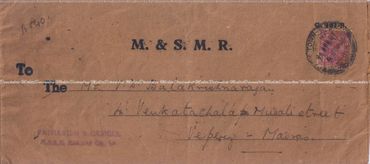
A 1941 Envelope from Madras and Southern Mahratta Railway
M&SMR
The Story
In the dust-choked Deccan of the 1870s, a nightmare unfolded. Famine struck with unerring regularity, starving millions across Madras and Bombay presidencies. Fields lay barren, grain prices doubled, and the road to Bellary became a battlefield strewn with the dead and dying. It was amid this human catastrophe that Southern Mahratta Railway Company (SMRC) was born, not for profit, but for survival.
The SMRC was formed on 1 June 1882, explicitly as a "famine feeder line". Its genesis lay in the Famine Commission's recommendation that railways should transport food grains into affected regions. English merchants had earlier proposed a line from Kanara to Hubli, but it was Sir T. Douglas Forsyth, an aristocratic British capitalist and the company's dynamic chairman, who secured permission from the Government of India to float the railway in London. The Rothschild banking house underwrote the prospectus, guaranteeing 4% interest on capital for seven years.
Construction began against impossible odds: challenging terrain, plague-ravaged countryside, and contractors who collapsed under the pressure. Messers Redmond & Stephens and Thompson, Bayley, Bulkley & Co. rescinded their contracts, forcing the company to build departmentally under Chief Engineer Colonel Lindsay. Lindsay was "an energetic man and a master of the situation" who pushed works through with greater celerity than contractors could have.
The first section, 40¼ miles from Bellary to Hospet, opened on 24 March 1884. By 1889, the network had exploded to 1,309 miles, including Mysore sections, an "enviable record of railroad construction". The line connected great cotton fields to the sea, expecting remunerative traffic from Manchester-quality fibre. Financially, the railway proved viable: expenses dropped from 108.5% of earnings in 1884 to 69% in 1886, remaining between 56–75% thereafter.
The Southern Mahratta system became a well-connected network, linking with the Great Indian Peninsula Railway at Poona, the Madras Railway at Guntakal, and the South Indian Railway at Dharmavaram. It possessed "the coolest and most convenient route between Bombay and Bangalore".
On 1 January 1908, as contracts approached their 25-year termination, the Government of India rearranged southern India's railway system. The Madras Railway merged with the Southern Mahratta Railway to form the Madras and Southern Mahratta Railway (M&SMR). The new company's headquarters began at Royapuram in Madras, then shifted to a newly constructed building at Egmore, inaugurated on 11 December 1922.
By 1936, the M&SMR owned 663 locomotives, 1,561 coaches, and 15,092 goods wagons. It was classified as a Class I railway under the 1926 Indian Railway Classification System.
The railway's story took a political turn during World War II. On 1 April 1944, the Government of India directly took over management. The company went into voluntary liquidation in February 1950, and the London Gazette published notice bringing "curtains down to one of the glorious chapter of company Railways in India".
The final transformation occurred on 14 April 1951, when the Madras and Southern Mahratta Railway, South Indian Railway, and Mysore State Railway merged to form Southern Railway, one of Indian Railways' 16 zones. The Egmore headquarters became Southern Railway's headquarters, where its centenary was celebrated in 2022.
The Madras and Southern Mahratta Railway's legacy is paradoxical: born from famine-death, it became a financial success; a private company, it operated as a government agent; and though liquidated, its network continues as Southern Railway, carrying millions daily along tracks first laid by emaciated relief labourers waiting to be fed.
"A second class railway is better than none"—Sir James Fergusson's 1884 words at Poona proved prophetic. The railway survived contractors, famines, and political change, transforming from a "famine protective work" into the backbone of southern India's transport network.
Sources:
https://en.wikipedia.org/wiki/Madras_and_Southern_Mahratta_Railway
https://en.wikipedia.org/wiki/Madras_Railway
https://irfca.org/faq/faq-hist.html
https://grokipedia.com/page/southern_mahratta_railway
https://swr.indianrailways.gov.in/view_section.jsp?lang=0&id=0,1,805,806,894
https://sriramv.com/2022/11/22/centenary-of-the-southern-railway-headquarters/
Devendra Mehta
Copyright © 2026 Devendra Mehta - All Rights Reserved.
Powered by GoDaddy Website Builder