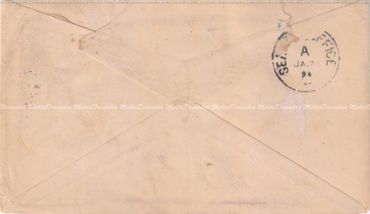
A 1895 Envelope to Orient Gas Company

Orient Gas Company
The Story
The Oriental Gas Company was established on 13th February 1857 under The Oriental Gas Company Act No. 5 of 1857. The Company was originally registered in England under The Joint Stock Companies' Act, 1856", with limited liability, for erecting gasworks on land granted by the Government in the vicinity of the Town of Calcutta, and for preparation of apparatus and materials for the manufacture and supply of Gas. The Act also had provisions for extension of operations to other towns and places.
In 1858, the company commenced operations and people of Calcutta had access to coal gas, distributed by the company. At that time, these companies used to supply coal gas, primarily for commercial use. The company continued to distribute coal gas as a fuel for more than 100 years till the 70s. The actual production was done in plants at Rajabazar and Howrah.
After Independence, the British sold the company to an Indian company i.e., Jalan & Co. In late 1950s, due to frequent breakdowns of old machines the business was not viable and closed down. However, The Oriental Gas Company was nationalised in 1960 and was rechristened Oriental Gas Company's Undertaking and supply of coal gas was initiated from Durgapur.
In the 1970s, the name was again changed to Greater Calcutta Gas Supply Corporation, and the company became a 100% state company of West Bengal Government. During 1990s, the Greater Calcutta Gas Supply Corporation Limited started getting coal gas from Dankuni Coal Complex, a subsidiary of Coal India Limited.
In 2016, Petroleum and Natural Gas Regulatory Board authorized the company to develop, expand and operate a CGD network in the Kolkata Municipal Corporation region, and adjoining districts of Nadia, North & South 24-Parganas, Hooghly and Howrah. The company formed a JV with GAIL (India) Limited under the aegis of Bengal Gas Company Limited to supply gas to customers in the domestic, transport, and commercial sectors.
Sources:
A 1927 Envelope of Shaw Wallace & Company


Shaw Wallace & Company
The Story
In 1868, ‘Shaw Jamieson & Co’ was founded in Calcutta by David Shaw and W. Jamieson. The Company become ‘Shaw Finlayson & Co’ in 1873-74, when Francis Finlayson became a partner on Jamieson’s death. In 1874 Charles William Wallace joined the firm’s London Agents. The business in Calcutta expanded into the Indian produce business, built a railway and developed enterprises in coal, timber and oil. The firm made an unsuccessful attempt to float the ‘Assam Railways and Trading Company’. Charles William Wallace worked in Calcutta from 1884-86 whilst R.Gordon Shaw, a relation of David Shaw, returned to London. The firm Shaw Wallace & Company (SWC) was created in 1886.
Throughout its long and rich journey, SWC has had many a first to its credit.
· In 1891, it became an agent of Burmah Oil Company.
· In 1909, it became an agent of Orenstein & Koppel for supply all types of light railway materials.
· It was the managing agent for following tea gardens: Assam Frontier Tea with tea gardens at Hilika, Talap, Dangori and Longsaol in the Tinsukia District; Hapjan Parabat and Balimara in the Dibrugarh District; and Budla Beta Tea Co Ltd with tea gardens at Bokpara, Pengaree, Kanjikoah and Kharjan in the Dibrugarh District.
· It was one of the first importers of motor cars in India during the beginning of the 20th century.
· It was also the first agent in India of a wireless company- Marconi's Wireless Telegraph.
· In 1926, it became an agent of the airline, the Imperial Airways.
· In 1944, it started its liquor business
Wallace established the Charles Wallace India Trust, which today provides scholarships for mid-career Indians to spend time in the United Kingdom.
SWC restructured its business in 1999, and sold Calcutta Chemicals Ltd and Detergents India Ltd to Henkel SPIC. In mid-2005, SWC's spirits business was acquired by United Breweries and was merged with United Spirits in 2008. Its breweries and beer business was acquired by SABMiller. Its whiskey brand Officers Choice was acquired by Allied Blenders and Distillers Limited. Allied got listed on exchanges in 2024.
Envelopes to Lloyd Triestino, Italy - 1927 from Delhi, Bombay & Amritsar And 1937 from Bombay
Lloyd triestino
The Story
Lloyd Triestino was an Italian insurance company established in 1833 which metamorphized into an ocean-liner company ferrying passengers across the globe. During World War II it lost 68 ships. In 1993, a Taiwanese company Evergreen Marine Corps entered in a partnership with Lloyd Triestino and eventually acquired them in 1998. It is primarily a container freight company now.
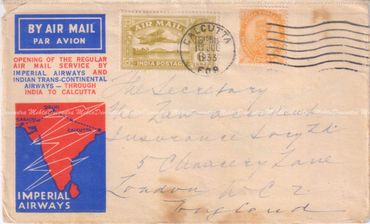
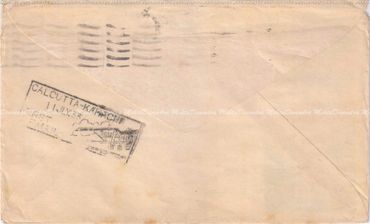
A 1933 Envelope to The Law Accident Insurance Company, England, from Calcutta, India
The Law Accident Insurance Company
The Story
The original Law Union and Rock Insurance Company, established in the UK, underwent several significant changes over the years:
- 1854: Founded as the Law Union Fire and Life Insurance Company.
- 1909: Merged with the Rock Life Assurance Company, becoming Law Union and Rock Insurance.
- 1919: Acquired by the London and Lancashire Fire Insurance Company.
- 1962: London and Lancashire was acquired by Royal Insurance, leading to the integration of Law Union and Rock into Royal Insurance.
- 1996: Royal Insurance merged with Sun Alliance to form Royal & Sun Alliance Insurance Group, now known as RSA Insurance Group.
As a result of these mergers and acquisitions, the original Law Union and Rock Insurance Company ceased to exist as an independent entity. Its legacy continues within the operations of RSA Insurance Group.
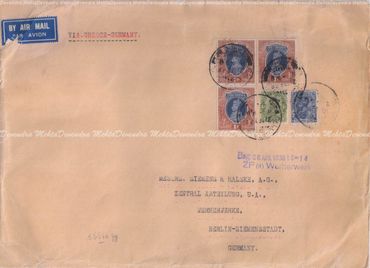
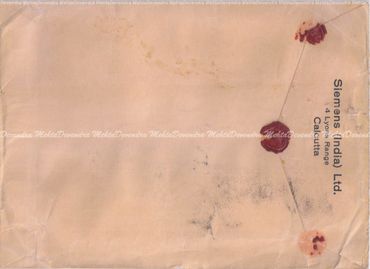
A 1938 Envelope to Siemens Halske A.G. from Siemens India Ltd.
A 1944 and 1945 Envelope to Mercantile Bank of India from Standard Bank of South Africa & National Provincial Bank, UK
Mercantile Bank of India
The Story
Mercantile Bank of India was founded in Bombay in 1853 as the Mercantile Bank of Bombay by Cowanjee Nanabhoy and Edwin Heycock. In 1858 the bank was renamed as Mercantile Bank of India, London, and China with a shift of headquarters to London and in 1893 was again renamed as Mercantile Bank of India.
The bank issued banknotes in Hong Kong, Singapore and Penang. It issued banknotes in Hong Kong from 1859 to 1892 and from 1912 to 1974. The bank had to close several offices amidst the World War II. Though, it opened the Hong Kong and Shanghai offices after the war it had to close down its Shanghai offices due to Communist Party dictates. The bank was acquired in 1959 by The Hong Kong and Shanghai Banking Corporation.
The current Headquarters of HSBC Bank in India is housed in the erstwhile offices of Mercantile Bank. However, the banking operations of Mercantile Bank were sold to Citibank who in-turn sold them to the Bank of Tokyo Mitsubishi.
Note: Please see mail from Mercantile Bank of India Bombay and Delhi to Lloyd Triestino, a shipping company, in reference to shipping document; one on particular refers to bill of lading.
Devendra Mehta
Copyright © 2026 Devendra Mehta - All Rights Reserved.
Powered by GoDaddy Website Builder