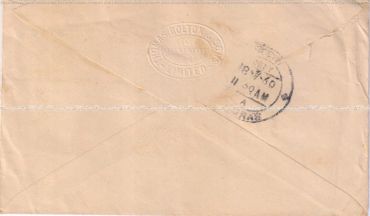
A 1906 Envelope from The Edwards Mills Company Ltd.
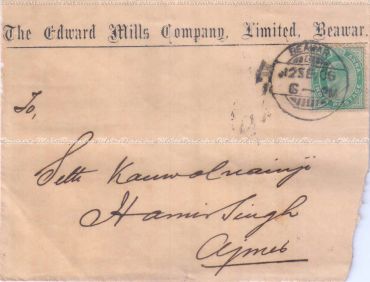
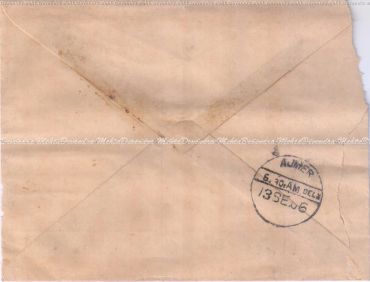
The Edwards Mills Company Ltd.
The Story
There was a time when you could almost tell the time in Beawar by the sound of the mills. The clatter of looms, the hum of machinery, workers streaming through factory gates, shops opening to serve them, and families building their lives amidst this commotion. At the heart of that industrial Beawar stood Edward Mills.
Today, the machinery is silent. But the story of the mill is really the story of a changing India. It began in 1906. On 6 July that year, Seth Guman Mal Lodha of Ajmer and Kunwar Ram Swarup of Beawar signed an agreement to establish a cloth mill in Beawar. They agreed to invest substantially in the venture and share its management equally. A little over a month later, on 9th August, The Edward Mills Company Ltd. was incorporated.
It was an age of enterprise, when Indian businessmen were beginning to build modern industries of their own. The town was already an important trading centre, particularly for cotton and wool. Edward Mills along with Krishna Mills, and Mahalaxmi Mills, created an industrial ecosystem that would make Beawar one of Rajasthan's better-known textile centres.
For the next several decades, Edward Mills grew with the town. In April 1960, the Mill became a Central Government undertaking. By 1961, Edward Mills and Mahalaxmi Mills together employed more than 2,600 people.
But the mill was not merely part of Beawar's economic history. It became part of India's legal history too. In 1954, Edward Mills found itself before the Supreme Court of India in a dispute concerning minimum wages for textile workers. The case, Edward Mills Co. Ltd., Beawar v. State of Ajmer, became an important constitutional decision concerning the government's power to prescribe minimum wages.
The mill was growing but so was the complexity of industrial India. Then came the difficult years. By the late twentieth century, India's old textile mills were struggling with ageing machinery, declining productivity and fierce competition. Edward Mills was no exception.
The numbers from 1993 tell the story better than words. The mill still had 681 workers, 14,328 spindles and 84 looms. But cloth production had fallen from 94.98 lakh metres in 1991–92 to 34.90 lakh metres in 1992–93. In 1993–94, it stood at just 7.94 lakh metres for the period reported to Parliament. The government tried to save it.
A plan was proposed to merge Edward Mills with neighbouring Mahalaxmi Mills, modernise the combined unit and tackle surplus manpower through voluntary retirement. An investment of ₹12.32 crore was envisaged for modernisation. But some battles are against competitors. Others are against time.
Edward Mills had been born in the age of steam and industrial optimism. By the 1990s, it was trying to survive in an industry being transformed by modern technology, productivity pressures and changing economics. Eventually, the numbers won. After almost 96 years, Edward Mills closed its gates on 6th May 2002.
And just like that, the sound that had been part of Beawar's life for generations disappeared. But perhaps a mill's life should not be measured only by the day its machines stop. The looms stopped in 2002. But the lives woven around them did not. That may be the most enduring legacy of Edward Mills. It did not merely manufacture cloth. For nearly a century, it helped manufacture Beawar itself.
Source:
https://censusindia.gov.in/nada/index.php/catalog/28658/download/31840/21786_1961_AJM.pdf
https://eparlib.sansad.in/bitstream/123456789/3261/1/lsd_10_8th_03-12-1993.pdf
https://indiankanoon.org/doc/121478/
https://supremetoday.ai/doc/judgement/01701970126
https://www.ntcltd.org/Writereaddata/Financial/2016-17.pdf
https://www.pib.gov.in/newsite/PrintRelease.aspx?lang=2®=48&relid=103403
https://www.indianlabourarchives.org/bitstream/20.500.14121/2364/1/AITUC_Center_Sect_1958-1959.pdf
https://sanipanhwar.com/uploads/books/2024-08-27_11-30-01_477101ca23f9ab925ce3351f49550af7.pdf
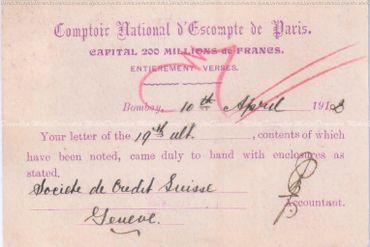
A 1912 Postcard addressed to Société the Credit Suisse

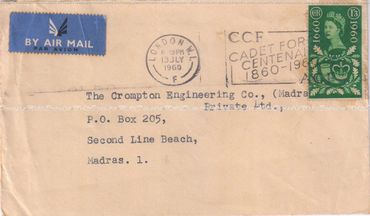
A 1960 envelope addressed to Crompton Engineering Co. Madras Pvt. Ltd. - Best & Crompton - UB Engineering
Devendra Mehta
Copyright © 2026 Devendra Mehta - All Rights Reserved.
Powered by GoDaddy Website Builder