A 1888 and 1906 envelope addressed to Ralli Brothers
Ralli Brothers
The Story
The Ralli family’s history can be traced to 15th or 16th century. They were originally from the island of Chios in the Ottoman Empire. The family claimed descent from the Frankish-Byzantine Raoul/Ralles noble lineage, which had relocated from Constantinople to Chios during the Byzantine era.
The Rallis’ patriarch Stephanos Ralli had established trade operations in Marseille, France, an important stop on the route to British Indian around 1800.
The turbulence of the era, especially the tragic Chios massacre of 1822 during the Greek War of Independence had forced many Greeks to seek fortunes abroad away from Ottoman Empire, in places like Odessa and Marseille. The Rallis were no exception.
Thus, in the early 19th century, five brothers, Zannis (John), Augustus, Pandias (called “Zeus”), Toumazis and Eustratios Ralli set out on a journey from Chios that would make their name one of the most remarkable in global trade. They recognized early that the world of trade was shifting after the Napoleonic Wars, and with ambition and vision they established “Ralli Brothers” in London in 1818.
Initially, like all successful traders, the brothers exploited the price differential, arbitraging between the goods originating in the Ottoman Empire and the British Empire. Gradually, the Ralli network expanded. Each brother took responsibility for different regions, building one of the largest merchant empires of the Victorian era. The repertoire of traded products was expansive, silk, cotton, linseed, hemp, jute, grain, rapeseed, sesame, turmeric, ginger, fruit and textiles etc.
By the late 19thcentury, the firm had presence in over 20 cities across continents; Europe, Asia and North America and employed tens of thousands of people. The real turning point in the Rallis’ story came in 1851, when the firm opened offices in Calcutta.
The catalyst was India’s booming demand for agricultural produce and trading goods under the British Raj. The Ralli Brothers quickly built deep involvement in commodities that mattered across the subcontinent. Their operations grew rapidly: by the late 19th century the firm employed thousands of clerks and labourers across warehouses and docks in India.
John Ralli, a younger scion of the family, was among the first to arrive in Calcutta and kick-start jute operations right before the onset of the Crimean War, a conflict that dramatically increased global demand for materials like grain and packing products.
Recognizing shifting global trade patterns once again, Ralli Brothers opened their Bombay office about a decade later, anticipating changes in cotton supply during the American Civil War and the resulting surge in cotton demand throughout Asia and Europe.
What set the Ralli Brothers apart was how they did business. They didn’t just trade, they leveraged networks across continents. When they saw the growing need for jute packaging, they invested in jute processing capacity; when they saw agricultural supply chains shifting, they moved into related businesses, even selling fertiliser and farm inputs long before India’s Green Revolution.
Their success in India wasn’t without controversy. During World War I, Ralli Brothers secured a major contract for supplying jute sandbags to the British War Office, drawing criticism from local competitors and some sections of Calcutta’s business community because of their Greek origins and foreign management. Yet paradoxically, many acknowledged that Ralli’s extensive rural reach and commodity expertise made them uniquely suited for the task.
The Great Depression of 1929 dealt a heavy blow to the Indian jute trade and global commodity markets. By 1931, the original Ralli operations in India were wound down, with tasks passing to local agents.
But this was not the end, it was at best an interlude. After India gained independence, the company was re-established as Rallis India Limited, under the holding company Ralli Brothers London on August 23, 1948. At that point, Rallis’ business mainly consisted of trading in cotton, jute and oilseeds. However, the urge for diversification continued and led to a fertiliser distribution partnership with the Nitrate Corporation of Chile.
In 1961, Ralli Brothers was acquired by Sir Isaac Wolfson, chairman of Great Universal Stores, for £5.5 million. Simultaneously, in 1962, family members Sir Godfrey Ralli and Lucas Ralli, established G & L Ralli Investment & Trustee Company as a new entity focused on investments.
In 1962, Tata-Fison, a Tata group company, acquired Rallis as Sir Isaac Wolfson decided to disinvest the Indian company. Later, Tata-Fison was merged with Rallis.
In 1981, the heart of Ralli’s empire, the trading operations including associated companies like Coney, were sold to Cargill Inc. The investment arm, G & L Ralli, continued until 1997, when it merged with Ely Fund Managers, the UK private banking division of the Dexia Group, further dispersing the family's financial legacy into broader European institutions.
Today, the legacy of the Ralli Brothers remains woven into the history of global commerce and into the story of modern India’s agricultural transformation.
References:
https://en.wikipedia.org/wiki/Ralli_Brothers
https://grokipedia.com/page/Ralli_Brothers
https://double-dolphin.blogspot.com/2014/09/ralli-brothers-hare-street.html
https://ahepahistory.org/biographies/Constantine-and-Pandias-Rallis-Brothers.html
https://ejournals.epublishing.ekt.gr/index.php/historicalReview/article/download/4044/3832
https://www.christopherlong.co.uk/per/rallibros.html
https://brill.com/display/book/9789004467729/BP000021.xml
https://www.hbs.edu/businesshistory/Documents/roy-trading-firms-colonial-india.pdf
https://christopherbellew.com/peter-calvocoressi/
https://www.hellenicaworld.com/Greece/Person/en/RalliBrothers.html
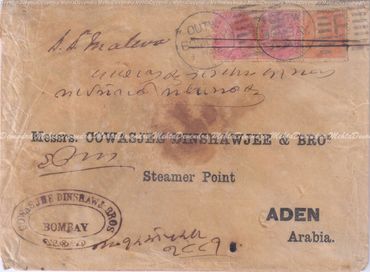
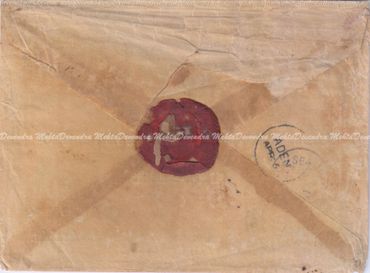
A 1889 envelope addressed to Cowasjee Dinshawjee & Bros, Aden
Cowasjee Dinshawjee Adenwalla
The Story
In the mid-19th century, Aden was a desolate volcanic outcrop. The British had captured it in 1839 to serve as a coaling station, but there were no roads, no housing, no fresh water, not even basic comforts. Into this unlikely setting stepped a Bombay Parsi merchant named Cowasjee Dinshaw (1827–1900), who transformed Aden into a thriving hub of empire and earned a name that still lingers: Adenwalla, the man of Aden.
Born in Bombay in 1827, Dinshaw came from the enterprising Parsi community that had already produced trading pioneers like Jamsetjee Jejeebhoy. By the 1850s, he had crossed the Arabian Sea and set up a trading house in Aden, dealing in grain, cotton, and cloth. But Dinshaw was more than a merchant. He quickly grasped that Aden was destined to be more than a dusty outpost, it could be the supply hub of the Indian Ocean world, connecting India with the Red Sea, East Africa, and Europe.
His foresight and honesty won him the trust of the British. When remittances from London were delayed, Dinshaw advanced money from his own coffers; when supplies ran short, he filled the gap. To the garrison, he was not just a trader, he was its banker, quartermaster, and lifeline.
Dinshaw also brought modern amenities to Aden. At great personal expense, he imported machinery from Europe to produce ice, potable water, and salt, luxuries the city had never known. For residents used to the relentless heat, the arrival of cold water and ice was nothing short of miraculous.
His ventures expanded far beyond Aden. His firm, Cowasjee Dinshaw & Bros., stretched its reach to Zanzibar, Djibouti, Mombasa, Hodeidah, and the Somali coast, making him one of the most important Indian Ocean merchants of his day.
Dinshaw’s wealth was matched by his generosity. In Aden, he funded schools, housing, wells, and dharamsalas for travelers and the poor. In Bombay, he contributed to hospitals, schools, and Parsi charitable institutions. To ensure that his work endured, he established the Cowasjee Dinshaw Charitable Trust, which continues to support causes more than a century after his passing.
So profound was his impact that his name became synonymous with Aden itself, Adenwalla. His descendants preserved his records - letters, contracts, and photographs, now known as the Cowasjee Dinshaw Collection of the Adenwalla Archive.
In Bombay, the Cowasjee Dinshaw Agiary, built by his family, still stands as a rare architectural link between Aden and India.
When Cowasjee Dinshaw died in 1900, he left not just a business empire but a city transformed by his vision. He had turned barren rock into a bustling port, given its people ice, water, and opportunity, and shown that commerce and philanthropy could go hand in hand.
For Aden, he was its maker. For Bombay, a benefactor. For his community, he remains Adenwalla, a name still spoken with respect, more than a century after his passing.
Philatelic Interest: The cancellation on the stamp is Jal Cooper Type 34.
Sources:
https://en.wikipedia.org/wiki/Cowasjee_Dinshaw_Adenwalla https://peterpickering.wixsite.com/aden/cowasjee-dinshaw https://zoroastrians.net/2020/06/08/the-cowasjee-dinshaw-collection-of-the-adenwalla-archive/ https://www.bombaywalla.org/archives
Life and Times of Sir Hormusjee C. Dinshaw by AN Joshi
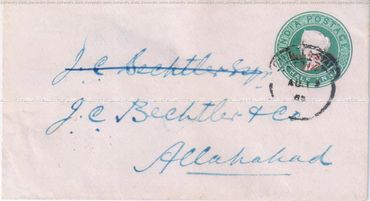
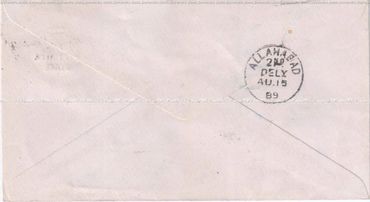
A 1899 envelope addressed to J.C. Bechtler
J C Bechtler
The Story
Messrs. J. C. Bechtler Son & Co. were silversmiths, jewellers, watchmakers and opticians. This business was established in Allahabad by Jouquin Carl Bechtler, in a small way, for the manufacture of jewellery and silverware, and was the first business of the kind to be established in India away from the Presidency towns. The business rapidly expanded, and in ten years' time moved to a handsome premise with a frontage of 120 feet. The firm has attained a high reputation in the manufacture of rings and jewellery of all descriptions, challenge-cups, shields, medals, and all kinds of sporting prizes, masonic jewellery, etc.
In the year 1887 Messrs. Bechtler Son & Co. were appointed jewellers and silversmiths to His Honour the Lieutenant-Governor of the United Provinces. The company had large stocks of diamonds, rubies, pearls, and every kind of precious stone. For twenty-two consecutive years they issued a yearly catalogue, showing all the novelties.
J. C. Bechtler was a native of Switzerland, and was apprenticed in the watchmaking trade. After completing five years of apprenticeship he travelled to France, Austria and Switzerland, perfecting his trade. In 1880 he travelled to India and established himself in Allahabad. He is a member of the Switzerland Geographical Society and the publisher of a journal devoted to jewellery and precious stones, "The Diamond."
A branch of the business was opened in 1889, at Mussoorie. He also had a workshop for manufacturing. The clock at the historic, Senate Hall and Clock Tower at Allahabad University was installed by J. C. Bechtler. Pocket watches manufactured by J.C. Bechtler are popular at auctions and fetch a good price.
He returned to Switzerland where his sons Hans and Walter established a cooling, heating and ventilation business called Luwa AG as well as a few other businesses.
Sources:
https://www.925-1000.com/forum/viewtopic.php?t=28477
A 1898 & 1935 envelope addressed to Volkart Brothers; Bombay & Switzerland Respectively. Also, one from Volkart Ujjain of 1946
Volkart Brothers
The Story
In 1851, brothers Salomon and Johann Georg Volkart established the firm of Volkart Brothers, with offices in Winterthur, Switzerland and Bombay, India. Their timing was prescient. European powers were deepening their colonial engagements in Asia, and India was emerging as a major hub for cotton and other commodities. The Volkart brothers recognized the potential of serving as intermediaries between Indian producers and global markets, and quickly positioned themselves as trusted merchant bankers and commodity traders.
From the outset, the company pursued a dual strategy: exporting Indian products like cotton, coffee, cocoa, spices, coir, and rubber to Europe, while importing machinery, paper, soap, textiles, and other European manufactured goods into the Indian market. This two-way trade proved highly profitable. When the American Civil War (1861–1865) disrupted cotton supplies, Volkart Brothers capitalized on soaring global demand for Indian cotton with presence deep in hinterland like the town of Ujjain & Beawar. Their reputation grew not only as traders, but also as financiers who extended credit and modern trading practices to Indian partners.
The company expanded rapidly. By the late 19th century, Volkart had opened offices in Colombo, Cochin, Karachi, and London, establishing a strong presence across Asia and Europe. In India, their network grew to over 80 branches, making them one of the largest European trading houses on the subcontinent. By 1926, the firm employed more than 7,600 people worldwide and had become the fourth largest cotton merchant globally. More than a commercial enterprise, Volkart Brothers embodied what historians now describe as “cosmopolitan capitalism”, a business model that blended Swiss capital and management with Indian enterprise and resources, straddling colonial boundaries in pursuit of global trade.
The company also left a strong industrial imprint in southern India. In Kerala, Volkart Brothers invested heavily in the coir industry, setting up large-scale factories in Alappuzha. These units modernized coir manufacturing and provided employment to thousands. Decades later, after the decline of European merchant houses, these assets were absorbed into the Kerala State Coir Corporation, and today, some former Volkart sites are being redeveloped into heritage museums that preserve the memory of Alappuzha’s industrial past.
By the mid-20th century, however, changing global trade patterns and India’s independence reshaped the fortunes of foreign trading houses. Volkart Brothers faced the challenge of redefining themselves in a world where nationalist policies and industrialization were replacing colonial-era trade networks. In 1954, another step was taken: Volkart Brothers joined hands with Tata Sons to form Voltas Ltd., headquartered in Mumbai; an anagram of “VOL” and “TAS”. Voltas inherited Volkart’s engineering and air-conditioning businesses, and a year later, the New York Times reported that the new venture would “take over Volkart jobs in India.” This marked a transition from commodity trading to industrial and engineering services, aligning with India’s economic priorities.
Voltas thrived and has become a household name in India, being the country’s leading air-conditioning and cooling company, and continues to acknowledge its Volkart roots.
Volkart Brothers’ other global commodity operations continued for some decades. However, by the 1980s, their independent role had diminished, and in 1989, their merchant trading activities were absorbed into Paul Reinhart Ltd., another Swiss trading house linked by family ties, involved in agriculture trading primarily cotton.
Their coffee division evolved into Volcafe, now part of ED&F Man, ensuring that the Volkart name lived on within the architecture of modern commodity trading giants.
Even after their trading empire wound down, the legacy of the Volkart family endures through the Volkart Foundation, established in 1951, which remains active in cultural and philanthropic work.
In Kerala, the coir factories and warehouses built by the firm are being restored as heritage sites, physical reminders of how a Swiss merchant house became entwined with the industrial and social fabric of a coastal Indian town.
Sources:
https://historicalleys.blogspot.com/2023/06/volkart-brothers-swiss-connection.html https://www.voltas.in/about/history
https://en.wikipedia.org/wiki/Volkart_Brothers
https://www.bennykuriakose.com/alappuzha-heritage-project-1/kerala-state-coir-corporation https://www.nytimes.com/1955/01/04/archives/tatas-in-new-concern-voltas-ltd-will-take-over-volkart-jobs-in.html
https://www.edfman.com/about/our-history/
A 1937 Envelope to Bhagwandas Bagla's successor
Bhagwandas Bagla
The Story
In the arid landscape of Shekhawati, where dust and ambition travel hand in hand, Bhagwandas Bagla was born in Churu, Rajasthan. He was the first Marwari from this region to become a crorepati (millionaire) and his story is a classic tale of enterprise, empire, and eventual erasure.
Bagla began as a timber merchant but like many Marwaris of his generation, he looked beyond the desert. He moved east, then further east still, until he reached Burma during the reign of King Thibaw. There, in the humid sprawl of Rangoon, he found opportunity in chaos.
When the Anglo-Burmese War broke out, Bagla did not flee; he became part of the military-industrial complex of that era. He built roads, bridges, and infrastructure for the British war machine.
He owned thousands of acres of paddy land facing Rangoon Harbour, operated several saw mills, and held properties across Rangoon, Mandalay, and Moulmein. He was banker, landlord, and merchant rolled into one, a one-man conglomerate. In February 1890, the British Raj acknowledged his stature with the title “Rai Bahadur.”
Bagla’s legend even touches the history of a beloved Indian sweet - rasgulla. According to a well-known story, whilst travelling his grandson was offered water and with it, a rasgulla. The boy loved it and Bagla was fascinated. Within a few years, the sweet’s fame had spread far beyond Bengal, helped by the endorsement of a man whose name carried weight across trade routes. Whether the now famous rasgullas of Bikaner have any connections with Bagla is a question that needs to be researched.
Bagla’s philanthropic activities matched his stature. He was instrumental in reshaping his hometown. Just before his death in 1895, he pledged ₹4.5 lakh to build a 60-bed hospital in Calcutta (the Marwari Hindu Hospital on Harrison Road, now Mahatma Gandhi Road), ₹1 lakh to the Maharaja of Bikaner for another 60-bed hospital, and funds for two 30-bed hospitals in Churu — one for men, one for women. Schools, temples, dharamshalas, and cremation ghats followed in India and Burma, from Rameshwaram to Benaras, from Rangoon to Mandalay.
Perhaps the most visible symbol of his philanthropic efforts is Sethani ka Johara, the “reservoir of the wealthy lady,” built by his widow during the devastating Chhappania Akal famine of 1899–1900. Designed as a relief project, it stored monsoon water year-round and, locals say, has never fully dried. Today, it draws nilgai and birds, a quiet monument to a family that once commanded harbours in Burma.
Bagla died in 1895, but his family’s empire endured for some time. Bagla's successors have also been associated with Netaji Subash Chandra Bose. Azad Hind Bank, established in Rangoon in April 1944, was housed in a building donated by the family of Bhagwandas Bagla. Similarly, the house in which Bose lived in Rangoon was donated by the family.
In the 1960s, Burma’s military regime nationalised almost every business in the country. Properties belonging to hundreds of thousands of Indians were seized; families were forced to leave. The Baglas, once masters of Rangoon’s skyline and hinterland, were among the dispossessed. What had been built over decades was extinguished by decree.
Bhagwandas Bagla’s life maps the arc of an entire community: from desert traders to imperial contractors, from local seths to transnational capitalists, and finally, in some theatres, to exiles. His businesses flourished in the cracks of empire, fed by war, trade, and mobility. They died not from competition or mismanagement, but from the sudden redraw of political borders and the rise of nationalist economics.
In Shekhawati, the havelis still stand, frescoed and fading. In Churu, Sethani ka Johara still holds water. But in Rangoon, the Bagla name survives mostly in old records and family memories — a reminder that in business, as in history, the line between flourishing and disappearing can be as thin as a government order.
Sources:
https://en.wikipedia.org/wiki/Bhagwandas_Bagla
https://www.travellingcamera.com/2013/12/high-tea-at-sethani-ka-johara-organized.html
https://www.tourism.rajasthan.gov.in/shekhawati.html
https://theverandahclub.com/article/bengal-diaries-episode-7-278
https://maddy06.blogspot.com/2022/03/the-azad-hind-bank-rangoon.html?m=1
A 1943 Envelope to David Sassoon & Co. and A 1944 Envelope to ED Sassoon & Co.
David Sassoon & Co.
The Story
In the early 19th century, the Sassoons, originating from Baghdad (with deeper roots perhaps reaching back to Aleppo), were a distinguished Jewish banking family, serving the Ottomans as treasurers. But as political tides shifted under the new wali, David Sassoon (1792–1864) emigrated in 1832, taking refuge in Bombay along with his large family and escaping persecution.
Fluent in Hebrew, Arabic, Persian, Turkish, and Hindustani (though he notably never mastered English), David Sassoon quickly carved his mark in Bombay’s mercantile landscape. He launched David Sassoon & Co. in a modest counting house at 9 Tamarind Street, trading in banking, property, silks, spices, wool, cotton yarn, and opium.
The firm expanded at a dizzying pace, establishing branches in Calcutta, Karachi, Hong Kong (1843), Canton, Shanghai (1845), and cities across Japan, the Persian Gulf, and the UK. Utilizing its own fleet of “opium clippers,” it dominated the India-China opium route, at one point handling 70% of Indian opium trade, surpassing competitors like Jardine Matheson and Dent & Co..
But David Sassoon’s vision went beyond the seams of commerce. He engaged in banking, helping establish HSBC in 1865 and funded the early Anglo-California Bank and the Imperial Bank of Persia. Back home, he nurtured community: founding the Magen David Synagogue (Byculla, 1861), a Talmud Torah school, Talmudic summer synagogue in Pune, and supporting famine relief, sailors’ homes, orphan funds, and more.
Upon David’s passing, eldest son Albert (Abdallah) took charge, ushering in the age of mill-building, textile manufacturing, and infrastructure that transformed Bombay into India’s industrial powerhouse. Albert launched cotton mills, the city’s first wet dock (Sassoon Docks, 1875), funded schools (like Elphinstone High), erected a statue of the Prince of Wales, and served on the Legislative Council.
Later, Elias David Sassoon struck out on his own in 1867, founding E.D. Sassoon & Co., which soon outgrew even the parent firm in capital and dynamism.
At the cusp of global trade, the Sassoons leveraged the post-Opium War openings. In 1844 Elias ventured to Canton, then Shanghai, where he planted deep roots. By the early 20th century, the family was among Shanghai’s elite, owning monumental structures including the Sassoon House (1929 Art Deco—today’s Fairmont Peace Hotel), once a glamorous haven of colonial high society.
Their ventures spanned insurance, shipping, rail loans, mills (rice, paper, flour), breweries, and laundries, diversifying across Asia.
Behind the glittering empire, the Sassoons opened doors for other Jewish families. Notably, the Kadoories, now famed owners of The Peninsula Hotels and Hong Kong’s China Light & Power; once worked for the Sassoons. Similarly, Silas Hardoon, who began in Bombay, rose to immense real estate wealth in Shanghai, his legacy enduring in the iconic Hardoon Building. By the 1930s, Baghdadi Jews, though few in number, owned much of Shanghai’s Bund, creating a lasting architectural and social imprint.
In Bombay, the Sassoons shaped the city’s geography and identity, places like Kala Ghoda and Sans Souci (David’s palatial Byculla residence) remain markers of their cultural imprint. David hosted Raj dignitaries, imbued his home with French elegance, and fostered a unique blend of identities: Jewish diaspora, Bombay cosmopolitanism, and colonial modernity.
But the empire would eventually wane. In the 1930s–40s, the Sassoons began divesting Bombay properties and gradually retreated, moving away to places like the Bahamas. Their lands gave way to the rise of India’s modern billionaire-driven skyline, but their architectural and philanthropic legacy endures.
Sources:
https://en.wikipedia.org/wiki/David_Sassoon_%26_Co. https://en.wikipedia.org/wiki/Sassoon_family
https://www.theindiaforum.in/history/rise-and-fall-sassoons https://scroll.in/magazine/1075379/how-the-sassoons-of-bombay-became-one-of-chinas-wealthiest-families
https://www.gatewayhouse.in/the-story-of-the-sassoons/ https://www.moneycontrol.com/news/business/david-sassoon-the-biggest-wealth-generator-in-bombay-4523271.html https://www.mcgm.gov.in/irj/go/km/docs/documents/D%20Ward/Heritage-Sites/97_Legacy%20of%20D%20Ward_Article_David%20Sassoon.pdf
Devendra Mehta
Copyright © 2026 Devendra Mehta - All Rights Reserved.
Powered by GoDaddy Website Builder