• Home
  • Articles
  • Papers
  • Restructuring Trivia
  • Testimonials
  • In Media
  • Philately
    • 1911 First Flight
    • 1920 RAF Flights
    • 1927 RAF Flight
    • 1928 Flights
    • 1929 Flights
    • 1931 Bombay - Goa Flight
    • 1931 Eng - Aus thru India
    • 1931 Other Flights
    • 1932 India - South Africa
    • 1932 Karachi Madras Flt
    • 1933 Imperial Trans Air
    • 1935 Bombay Calcutta Flt
    • 1938 Coogee Flight
    • Thematic
  • More
    • Home
    • Articles
    • Papers
    • Restructuring Trivia
    • Testimonials
    • In Media
    • Philately
      • 1911 First Flight
      • 1920 RAF Flights
      • 1927 RAF Flight
      • 1928 Flights
      • 1929 Flights
      • 1931 Bombay - Goa Flight
      • 1931 Eng - Aus thru India
      • 1931 Other Flights
      • 1932 India - South Africa
      • 1932 Karachi Madras Flt
      • 1933 Imperial Trans Air
      • 1935 Bombay Calcutta Flt
      • 1938 Coogee Flight
      • Thematic
  • Home
  • Articles
  • Papers
  • Restructuring Trivia
  • Testimonials
  • In Media
  • Philately
    • 1911 First Flight
    • 1920 RAF Flights
    • 1927 RAF Flight
    • 1928 Flights
    • 1929 Flights
    • 1931 Bombay - Goa Flight
    • 1931 Eng - Aus thru India
    • 1931 Other Flights
    • 1932 India - South Africa
    • 1932 Karachi Madras Flt
    • 1933 Imperial Trans Air
    • 1935 Bombay Calcutta Flt
    • 1938 Coogee Flight
    • Thematic

A 1875 Envelope Addressed to Sylk's Hotel

Sylk's / Savoy Hotel, Ooty

The Story

The Savoy Hotel has been in existence since 1841. It was built by H. Royal Dawson and was then called Dawson’s Hotel. It was built around the cottage called Woodwille which is now the Garden Cottage at the hotel. In 1868, the name of the hotel was changed to Sylk’s Hotel, and thereafter to Savoy Hotel. (See an envelope addressed to the Sylk’s Hotel above) The hotel was renovated in 2018 and is now part of Taj Hotels (Indian Hotels Company Limited)


Back to Restructuring Trivia

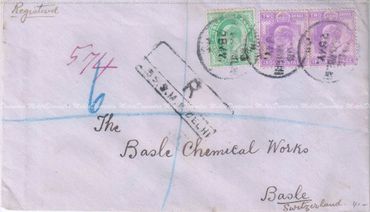
An 1908 envelope addressed to Basle Chemical Works, Switzerland

BaSLE Chemical Works

The Story

The city of Basel (Basle) in Switzerland became a major centre of the chemical and pharmaceutical industries beginning in the late 19th century. This arose largely from synthetic dye production and later expanded into pharmaceuticals, agrochemicals, plastics and other specialty chemicals.


In the book, The Manufacture of Intermediate Products for Dyes by John Cannell Cain, the name Basle Chemical Works appears a number of times – a few instances quoted below; 


“Phthalylhydroxylamine yields anthranilic acid when boiled with sodium carbonate (Basle Chemical Works, G.P., 130301, 130302)…When phthalimide is oxidised in alcoholic solution, anthranilic ester is obtained (Basle Chemical Works, G.P., 139218)”. – Page 148


“According to the Basle Chemical Works (G.P., 145376), the above process gives only a 60 per cent, yield of the theoretical” – Page 157


“Some other processes have also been patented ; thus, naphthols and other naphthalene derivatives are heated in the presence of a very slight excess of alkali, with metallic oxides or peroxides, such as copper and iron oxides or barium, lead or manganese peroxides, to 240-260 for eight hours in an atmosphere of oxygen under pressure (Basle Chemical Works, E.P., 15527 of 1901” – Page 164


However, no entity by the name Basle Chemical Works exist. The German translation of Basle Chemical Works is "Chemische Werke Basel". The company traces its origin to Basle in 1859 and was started by Alexander Clavel. In 1873, Clavel sold his factory to Robert Bindschedler and Albert Busch. In 1884, Bindschedler & Busch rename it to Gesellschaft für Chemische Industrie (again, may be translated to Basle Chemical Works). In 1893, Robert Bindschedler founds Basler Chemische Fabrik AG. These entities were later known as Ciba.


Ciba produced synthetic dyes from 1884 onwards. Today, the company's legacy is absorbed into the Basel-based pharmaceutical giants Novartis and Sandoz. 


It was the pioneer in the production of fuchsin (a red dye) for silk dyeing. Chemische Werke Basel (Ciba) merged with J.R. Geigy in 1970 to form Ciba-Geigy. In 1996, Ciba-Geigy and Sandoz merged to form the pharmaceutical company Novartis. Ciba Specialty Chemicals, the pure chemicals and plastics divisions were spun off as Ciba Specialty Chemicals in 1997 and acquired by the German company BASF in 2008. 


Today the old chemical plants still shape Basel's industrial landscape (e.g., in the Klybeck and Rosental Mitte areas). Novartis and the spun-off Sandoz remain headquartered in Basel. 


The historical working environment and the history of "Basel's chemical industry" can be seen firsthand at the Basel Chemistry Museum though exhibits may not date back to its very early days.


Back to Restructuring Trivia


Sources:

 https://en.wikipedia.org/wiki/Novartis

https://www.basel.com/en/attractions/chemiemuseum-basel-0ebbd67fa2

25 years of Novartis; 250 years of innovation

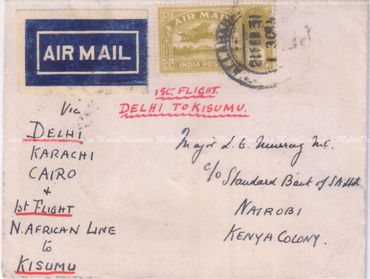
A 1931 Envelope to Standard Bank of South Africa - Standard Bank merged with Chartered Bank in 1969 to form Standard Chartered Bank

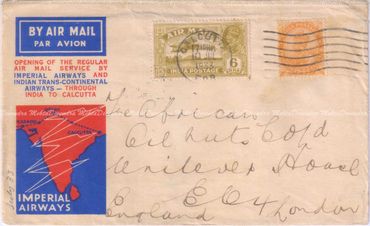
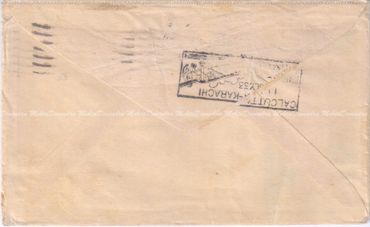
A 1933 Envelope to The African Oil Nut Company Ltd, England, from Calcutta, India

The African Oil Nut Company

The Story

The African Oil Nuts Company Limited was Established in 1916 with a Head Office at Central House, Kingsway, London and branches in Lagos, Kano, Zaria, Badagry, Opobo, Eket, Egwanga, Aba, Udi and Port Harcourt. 


It was purchased by Lever Bros Ltd, and subsequently vested in the Niger Company on September 24, 1960.


These companies have now become Unilever Nigeria Plc.


Back to Restructuring Trivia

A 1937 Envelope from The Nederlandsch Indische Handelsbank

The Story

The Nederlandsch-Indische Handelsbank (NIHB, Dutch East Indies Trade Bank) was established in 1863 to finance trade between the Netherlands and the Dutch East Indies.


In 1920 the bank opened branches in Bombay, Calcutta, Shanghai, and Kobe to aid in cotton trading with Japan.


In 1959, its Indonesian activities were nationalized and eventually led to the formation of Bank Mandiri in 1998. In 1960, NIHB's remaining activities were acquired by the Rotterdamsche Bank. The bank in turn merged with Amsterdamsche Bank to create AMRO Bank. A few more mergers ensued which finally resulted in creation of the ABN AMRO Bank.


Back to Restructuring Trivia


Source:

https://en.wikipedia.org/wiki/Nederlandsch-Indische_Handelsbank


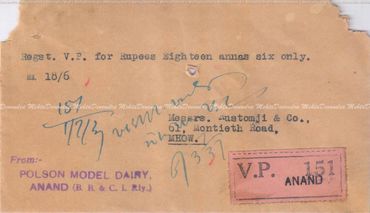
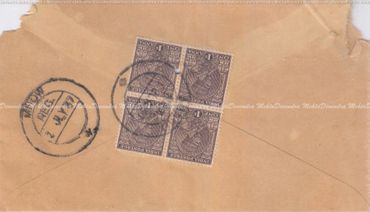
A 1944 Envelope From Polson Model Dairy, Anand, Gujarat

Polson Model Dairy

The Story

Polson is the name of a dairy products brand that was started in India by Pestonjee Eduljee in 1915 in Mumbai. Polson's first dairy was set up in Anand, Gujarat in 1930.


People in India used to buy butter and milk from the milkmen directly till the advent of Polson. During World War I the company supplied Polson Butter and Polson's Pure coffee to British Indian and American forces. At its peak, it was producing up to 5 tons of butter every day. To meet the demands of the forces a new factory and office was started in Bombay.


By 1945, Polson was producing 3 million pounds of butter every year. However, the company did not do much to help improve the condition of Indian farmers. This was brought to the attention of Sardar Vallabhbhai Patel, who had been contemplating opening a cooperative society. This led to the formation of Amul, a milk cooperative, on 14 December 1946. Thereafter, the dairy operations of Polson declined. 


Polson then diverted the business focus towards vegetable tanning extracts, dyes and pigments for leather products. Today the company is Asias largest manufacturer and exporter of natural based vegetable tannin extracts and Eco-friendly leather chemicals.


Back to Restructuring Trivia


Sources:

https://en.wikipedia.org/wiki/Polson_(brand) 

http://www.polsonltd.com/aboutpolson.htm

  • Home
  • Bank Restructurings
  • Corporate Turnarounds
  • Forgotten Entrepreneurs
  • Liquidation-1800s
  • Liquidation-1900s
  • Liquidations-2000s
  • Transformation Over Time
  • Transformation by Fiat
  • Insolvency Archives

Devendra Mehta

Copyright © 2026 Devendra Mehta - All Rights Reserved.

Powered by GoDaddy Website Builder

This website uses cookies.

We use cookies to analyze website traffic and optimize your website experience. By accepting our use of cookies, your data will be aggregated with all other user data.

DeclineAccept