A 1875 Envelope Addressed to Sylk's Hotel


Sylk's / Savoy Hotel, Ooty
The Story
The Savoy Hotel has been in existence since 1841. It was built by H. Royal Dawson and was then called Dawson’s Hotel. It was built around the cottage called Woodwille which is now the Garden Cottage at the hotel. In 1868, the name of the hotel was changed to Sylk’s Hotel, and thereafter to Savoy Hotel. (See an envelope addressed to the Sylk’s Hotel above) The hotel was renovated in 2018 and is now part of Taj Hotels (Indian Hotels Company Limited)
A 1893 Envelope Addressed to The Bank of Bombay
Bank of Bombay
The Story
The bank was established in 1840 and was based in Bombay. Though, a commercial bank, it undertook certain functions of Central Bank as the Reserve Bank of India was not established at that time. It was merged with the two other Presidency Banks, the Bank of Calcutta and the Bank of Madras and was renamed Imperial Bank of India in 1921. In 1955 the merged entity was renamed the State Bank of India. Bank.
Envelopes Addressed to the Bank of Bengal : Agra - 1895; Cawnpore - 1899; Hyderabad - 1905
Bank Of Bengal
The Story
The Bank of Calcutta was founded in 1806 and was renamed Bank of Bengal in 1809.
The bank was risk averse and limited lending to a period of three months, leading to launch of other banks, many of which failed. The Bank of Calcutta, and the two other Presidency banks i.e., the Bank of Bombay and the Bank of Madras amalgamated in 1921 to form the Imperial Bank of India. In 1955 the merged entity was renamed as the State Bank of India.
The sender of the 1905 envelope is National Bank of India. See postal history of National Bank of India here and read about the bank here.
A 1945 letter from Bank of Bengal can be seen here.
Source:
An 1908 envelope addressed to Basle Chemical Works, Switzerland


BaSLE Chemical Works
The Story
The city of Basel (Basle) in Switzerland became a major centre of the chemical and pharmaceutical industries beginning in the late 19th century. This arose largely from synthetic dye production and later expanded into pharmaceuticals, agrochemicals, plastics and other specialty chemicals.
In the book, The Manufacture of Intermediate Products for Dyes by John Cannell Cain, the name Basle Chemical Works appears a number of times – a few instances quoted below;
“Phthalylhydroxylamine yields anthranilic acid when boiled with sodium carbonate (Basle Chemical Works, G.P., 130301, 130302)…When phthalimide is oxidised in alcoholic solution, anthranilic ester is obtained (Basle Chemical Works, G.P., 139218)”. – Page 148
“According to the Basle Chemical Works (G.P., 145376), the above process gives only a 60 per cent, yield of the theoretical” – Page 157
“Some other processes have also been patented ; thus, naphthols and other naphthalene derivatives are heated in the presence of a very slight excess of alkali, with metallic oxides or peroxides, such as copper and iron oxides or barium, lead or manganese peroxides, to 240-260 for eight hours in an atmosphere of oxygen under pressure (Basle Chemical Works, E.P., 15527 of 1901” – Page 164
However, no entity by the name Basle Chemical Works exist. The German translation of Basle Chemical Works is "Chemische Werke Basel". The company traces its origin to Basle in 1859 and was started by Alexander Clavel. In 1873, Clavel sold his factory to Robert Bindschedler and Albert Busch. In 1884, Bindschedler & Busch rename it to Gesellschaft für Chemische Industrie (again, may be translated to Basle Chemical Works). In 1893, Robert Bindschedler founds Basler Chemische Fabrik AG. These entities were later known as Ciba.
Ciba produced synthetic dyes from 1884 onwards. Today, the company's legacy is absorbed into the Basel-based pharmaceutical giants Novartis and Sandoz.
It was the pioneer in the production of fuchsin (a red dye) for silk dyeing. Chemische Werke Basel (Ciba) merged with J.R. Geigy in 1970 to form Ciba-Geigy. In 1996, Ciba-Geigy and Sandoz merged to form the pharmaceutical company Novartis. Ciba Specialty Chemicals, the pure chemicals and plastics divisions were spun off as Ciba Specialty Chemicals in 1997 and acquired by the German company BASF in 2008.
Today the old chemical plants still shape Basel's industrial landscape (e.g., in the Klybeck and Rosental Mitte areas). Novartis and the spun-off Sandoz remain headquartered in Basel.
The historical working environment and the history of "Basel's chemical industry" can be seen firsthand at the Basel Chemistry Museum though exhibits may not date back to its very early days.
Sources:
https://en.wikipedia.org/wiki/Novartis
https://www.basel.com/en/attractions/chemiemuseum-basel-0ebbd67fa2
25 years of Novartis; 250 years of innovation
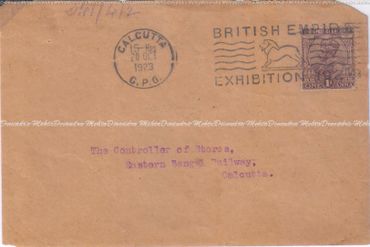
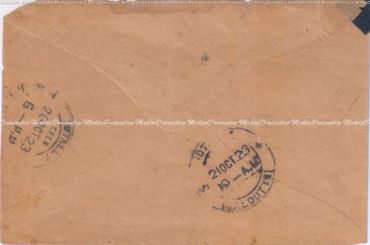
A 1923 Envelope to Eastern Bengal Railway
Eastern Bengal Railway
The Story
In the shadow of the 1857 Indian Rebellion, a quiet revolution was being forged in London. On July 30, 1858, the Eastern Bengal Railway Company signed a contract with the East India Company for a transformative mission: connecting Calcutta on the eastern bank of the Hooghly River to Kushtia, a distance of 110 miles estimated at one million pounds sterling .
Railways had arrived in England during the Industrial Revolution of the 1820s, but British capitalists doubted their commercial profitability in distant colonies like India. The government resolved this by offering a 5% guaranteed interest on capital invested, attracting British capital to build India's railways. The first railway line in India was introduced in 1853 between Bombay (now Mumbai) and Thane. The success of this line encouraged the British to expand railway networks across India, including Bengal.
The railway was planned to serve densely populated districts north and east of Calcutta, rich in agricultural produce — indigo, sugar, oilseeds, and rice. The line opened for the entire length in November 1862, ending at a tin-roofed station room at Sealdah, Calcutta's first railway terminal. A short branch line, two and a half miles long, extended from near Kushtia to a river port on the Garai River by 1864.
In 1865, the decision was made to extend the line from Kushtia 45 miles to Goalundo, at the confluence of the Ganges and Brahmaputra rivers. This required constructing a bridge over the Garai River. Viceroy Lord Mayo opened the extended line on December 31, 1870.
The government purchased the railway in 1884 through the Eastern Bengal Railway Company Purchase Act. In 1885, the Eastern Bengal Railway, which operated east of Hooghly River, was linked by a bridge between Bandel and Naihati, with the East Indian Railway, which operated west of Hooghly River. In 1887, it amalgamated with the Northern Bengal State Railway and was renamed it Eastern Bengal State Railway.
The railway had proved its worth immediately. By 1865, revenue alone maintained the entire railway, shifting from capital charges to self-sustaining operation. It used Burdwan coal from the start, with fuel costs dropping after bridges at Naihati and Howrah were completed.
The 1895 opening of the Assam-Bengal Railway between Chittagong and Comilla served tea companies exporting via Chittagong port. By 1902, the railway stretched north along the Brahmaputra's north bank to Dhubri in Eastern Assam, driven partly by pressure from the Indian Tea Association seeking an easy outlet for Assam tea to Calcutta. On January 1, 1942, Eastern Bengal State Railway and Assam Bengal Railway amalgamated to form the Bengal and Assam Railway.
By the early 20th century, Bengal had more railways per area than any province except the United Provinces . The railway provided cheaper, faster, and more comfortable transport than the hazardous river journeys in country boats that had dominated pre-railway trade .
The 1947 Partition divided the railway. The Indian portion became part of Eastern Railway (Sealdah Division) and Northeast Frontier Railway, while East Pakistan's portion became Eastern Bengal Railway, later Pakistan Eastern Railway, and finally Bangladesh Railway after 1971.
As one contemporary observer noted, the railway "left an indelible mark on 19th-century developments in India," providing the foundation for modern economic expansion by facilitating passenger and freight movement at "hitherto unparalleled speeds". Today, the Sealdah Division serves six West Bengal districts between the Hooghly River and Bangladesh, continuing the historic journey.
Sources:
https://en.banglapedia.org/index.php/Eastern_Bengal_Railway
https://irfca.org/members/sites/mrinal/history_er.html
https://er.indianrailways.gov.in/print_section.jsp?lang=0&id=0%2C6%2C442%2C452
https://railpolice.wb.gov.in/HistoryofIndianRailwaysinWestBengal
A 1931 Envelope to Standard Bank of South Africa - Standard Bank merged with Chartered Bank in 1969 to form Standard Chartered Bank


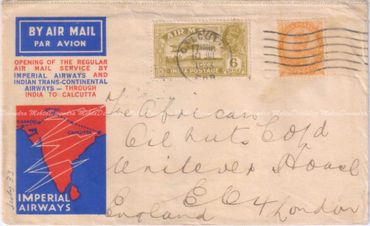
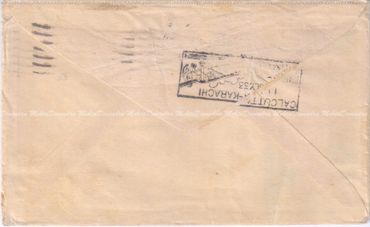
A 1933 Envelope to The African Oil Nut Company Ltd, England, from Calcutta, India
The African Oil Nut Company
The Story
The African Oil Nuts Company Limited was Established in 1916 with a Head Office at Central House, Kingsway, London and branches in Lagos, Kano, Zaria, Badagry, Opobo, Eket, Egwanga, Aba, Udi and Port Harcourt.
It was purchased by Lever Bros Ltd, and subsequently vested in the Niger Company on September 24, 1960.
These companies have now become Unilever Nigeria Plc.
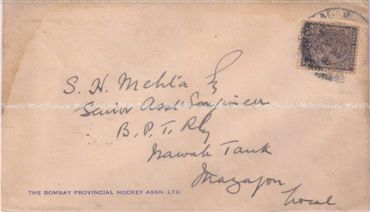
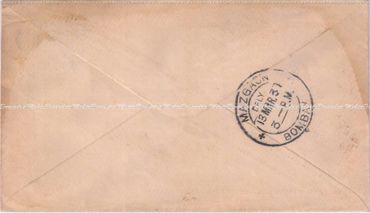
A 1937 Envelope to BPT Railway
BPT Railway
The Story
Before 1914, Bombay's docks existed in a kind of logistical limbo. Though ships unloaded their cargoes beneath the Arabian sun, the port remained strangely disconnected from the railway networks that were stitching together the Indian hinterland. Import and export goods moved from ship to rail, and vice versa, hauled in bullock carts across dusty roads. It was an expensive, slow method, bottlenecking the city's growing trade.
The two main railways, the GIP (later Central Railway) and the BB & CI (later Western Railway), had responded to rising traffic by laying capacious goods yards near Prince's and Victoria Docks, connected by just three sidings crossing Frere Road (now P. De'Mello Road). But these sidings could accommodate only a fraction of the port's volume. The city needed something bolder.
On 1 January 1915, the Bombay Port Trust Railway (also known as the Mumbai Port Trust Railway) was commissioned, changing the port's destiny forever. The designers enjoyed a rare advantage: ample land. This allowed them to adopt the best alignment and the most modern principles of railway transportation without disturbing existing interests. The result was a meticulously planned network linking the docks, bunders, and various depots to the two contiguous mainline railway systems.
The railway was small in size but mighty in impact. By 1969–70, its inward and outward traffic totalled 3.70 million tonnes, with an additional 1.67 lakh tonnes of local, station-to-station traffic . The Port Trust Railway handled about 60 per cent of Bombay city's total rail-borne goods traffic.
A Network of Ten Stations
The system spanned 11.3 route kilometres but boasted 312 track kilometres, a testament to its intricate web of sidings and depots. Ten stations served the docks and depots:
- Wadala Oil Depot
- Stores and Coal Depot
- Manganese Depot
- Grain Depot
- Cotton Depot
- Panton Bunder
- Prince's and Victoria Docks
- Alexandra Dock
- Ballard Pier
Wadala, at the extreme north end, functioned as the junction station and main marshalling yard. Goods trains arrived in the Up Arrival Yard, then were sorted over a hump by gravity – wagons rolled down and diverted along different lines by hand points. Outward loaded traffic received in the Down Arrival Yard was sorted over the Down Gravity Hump, forming trains for the Western and Central Railways and beyond.
The steam and diesel loco sheds sat at the south end of Wadala Yard, alongside a small goods shed. In 1936, the company owned 26 locomotives and 684 goods wagons. The last steam locomotives were retired in 1976, marking the end of an era.
The Port Trust Railway's role extended far beyond cargo. During World War II, it carried passengers and troops, serving the war effort. In the 1920s and 1930s, Ballard Pier Mole station became the starting point for the Frontier Mail (now the Golden Temple Mail), one of India's legendary long-distance trains. The excellent terminal railway facilities provided by the Bombay Port Trust contributed materially to the city's development; a direct consequence of that visionary 1915 project.
Sources:
https://en.wikipedia.org/wiki/Mumbai_Port_Trust_Railway
https://mumbaiport.gov.in/show_content.php?lang=1&level=1&ls_id=1042&lid=56
A 1937 Envelope from The Nederlandsch Indische Handelsbank
The Story
The Nederlandsch-Indische Handelsbank (NIHB, Dutch East Indies Trade Bank) was established in 1863 to finance trade between the Netherlands and the Dutch East Indies.
In 1920 the bank opened branches in Bombay, Calcutta, Shanghai, and Kobe to aid in cotton trading with Japan.
In 1959, its Indonesian activities were nationalized and eventually led to the formation of Bank Mandiri in 1998. In 1960, NIHB's remaining activities were acquired by the Rotterdamsche Bank. The bank in turn merged with Amsterdamsche Bank to create AMRO Bank. A few more mergers ensued which finally resulted in creation of the ABN AMRO Bank.
Source:
https://en.wikipedia.org/wiki/Nederlandsch-Indische_Handelsbank

A 1912 Card from Standard Vacuum Oil, A 1941 Envelope to Standard Vacuum & A 1937 Envelope to Socony Vacuum
Standard Vacuum Oil Company
The Story
The envelope above travelled from Portuguese India to British India.
The Standard Vacuum Oil Company was established in 1931 as a joint venture between Standard Oil of New Jersey and Socony-Vacuum Oil (See envelope addressed to New York City above), which was later known as Mobil. Socony stood for the Standard Oil Company of New York which was formed in 1882. Vacuum Oil was formed in 1866. In 1931, Socony had merged with Vacuum Oil to create Socony-Vacuum Oil.
During the 1950s, disagreements arose between the partners, ultimately leading to their split in 1962. As a result, two companies were formed: Jersey Standard Southeast Asia and Mobil Oil Southeast Asia. Interestingly, in 1999, the two entities reunited, merging to form the now-famous ExxonMobil.
In India, the company started its operations in 1910 as Standard Oil Company of New York and thereafter changed its name in 1931 to Socony-Vacuum Oil. In 1951, the company signed an agreement with Government of India to set up a refinery at Trombay. A new company Standard Vacuum Refining Company of India was incorporated. The company started manufacturing motor gasoline and expanded to LPG, JBO, asphalt, SBP spirit, hexane, naptha, petroleum ether and propane.
In 1954, Socony-Vacuum Oil built the iconic Petroleum House in Bombay and relocated its headquarters there, which was inaugurated by the then Chief Minister, Morarji Desai. The building was notable for its modern and environmentally friendly design, featuring open office spaces. In 1974, the company was nationalized and rebranded as Hindustan Petroleum Corporation Limited (HPCL).
The sender of the letter is Vita Pack Corporation. Not much is known about Vita Pack Corporation, but the company played a significant role in the history of cashew nut exports from India. In the late 1920s, American businessmen from Vita Pack Corporation and General Food Corporation collaborated with Shri Narayan Zantye, a pioneer in the cashew processing industry in Goa. They provided technical and financial assistance to successfully export cashew kernels to the U.S. for the first time in 1928. This partnership marked the beginning of a thriving cashew export industry in Goa.
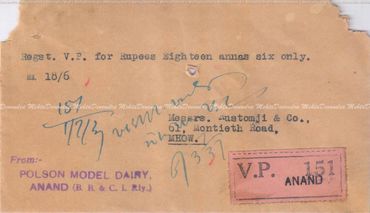
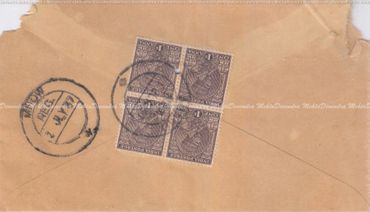
A 1944 Envelope From Polson Model Dairy, Anand, Gujarat
Polson Model Dairy
The Story
Polson is the name of a dairy products brand that was started in India by Pestonjee Eduljee in 1915 in Mumbai. Polson's first dairy was set up in Anand, Gujarat in 1930.
People in India used to buy butter and milk from the milkmen directly till the advent of Polson. During World War I the company supplied Polson Butter and Polson's Pure coffee to British Indian and American forces. At its peak, it was producing up to 5 tons of butter every day. To meet the demands of the forces a new factory and office was started in Bombay.
By 1945, Polson was producing 3 million pounds of butter every year. However, the company did not do much to help improve the condition of Indian farmers. This was brought to the attention of Sardar Vallabhbhai Patel, who had been contemplating opening a cooperative society. This led to the formation of Amul, a milk cooperative, on 14 December 1946. Thereafter, the dairy operations of Polson declined.
Polson then diverted the business focus towards vegetable tanning extracts, dyes and pigments for leather products. Today the company is Asias largest manufacturer and exporter of natural based vegetable tannin extracts and Eco-friendly leather chemicals.
Sources:
Devendra Mehta
Copyright © 2026 Devendra Mehta - All Rights Reserved.
Powered by GoDaddy Website Builder